Introduction: Why Does DMT’s Duration Matter?
People often wonder how long DMT lasts because its effects are famously intense yet surprisingly brief. Understanding the duration is important for safety and planning – for example, someone might want to know if a DMT vape pen trip will be over in minutes or if an ayahuasca ceremony will occupy an entire evening. DMT (N,N-Dimethyltryptamine) is unique among psychedelics for its short-lived peak, earning it nicknames like the “businessman’s trip” since a user can experience a full psychedelic journey in much less time than substances like LSD or psilocybin mushrooms .
Despite this short clock-time, the experience can feel subjectively long due to the mind-bending nature of the drug. In this guide, we’ll answer common questions about DMT’s onset, peak, and total duration for various forms (from smoked DMT vapes to ayahuasca) and compare it to other psychedelics, all backed by research and expert reports.
Caption: Brewing ayahuasca, a traditional DMT-containing brew. When DMT is taken orally in an ayahuasca tea with MAOIs (as shown above), the psychoactive effects last for hours, compared to the minutes-long trip from smoking or vaping DMT.
How Long Does a DMT Trip Last? (Quick Answer)
A DMT trip is extremely short when smoked or vaporized – on the order of minutes – but can last several hours when taken orally (ayahuasca). Here’s a quick breakdown of DMT’s duration by method of use:
- Smoked or Vaped DMT: The intense effects are typically felt for about 5 to 15 minutes, with the entire experience (including come-up and come-down) usually wrapping up within 30 minutes . In other words, using a DMT pipe or DMT vape cartridge delivers a rapid, breakthrough experience that is mostly over in under half an hour.
- Ayahuasca (Oral DMT Brew): 4–6 hours of effects on average. Ayahuasca is a brewed tea combining DMT-containing plants with MAOI-containing plants, allowing DMT to be active orally. The trip unfolds much more slowly and lasts a few hours , more comparable to a long psilocybin mushroom experience than to smoked DMT.
- 5-MeO-DMT (DMT Analog): Roughly 15–45 minutes when vaporized. 5-MeO-DMT, a potent relative of DMT, also acts very quickly. If smoked, the main effects may last as little as 10 minutes, with peak effects in the 10–30 minute range . (Insufflated or injected, 5-MeO-DMT’s effects can last longer, up to 1–2 hours, but those routes are less common .)
To put it in perspective, a smoked DMT trip is over in the time it takes to watch a TV sitcom, whereas an ayahuasca journey can last as long as a Lord of the Rings movie. This is in stark contrast to other psychedelics like LSD (which can last 10+ hours) or standard psilocybin mushrooms (4–6 hours) . The brevity of DMT’s action is a key characteristic that draws both curiosity and caution – it’s short, but it’s incredibly intense while it lasts.
How Quickly Does DMT Kick In (Onset Time)?
DMT’s onset is almost instantaneous when smoked or vaped, whereas ayahuasca (oral DMT) takes significantly longer to kick in. The route of administration makes a huge difference in how fast the effects begin:
- Smoked or Vaped DMT Onset: Expect effects within seconds to a minute. When inhaled from a pipe or DMT vape pen, DMT enters the bloodstream via the lungs and reaches the brain very fast. Users often report beginning to hallucinate within 30–45 seconds of exhaling a hit . In many cases, by the time you’ve put the pipe down, the visuals and altered consciousness are already surging. This rapid onset can be startling – there is essentially no waiting period; one moment you’re sober, and seconds later you’re in a full psychedelic experience.
- Ayahuasca (Oral) Onset: Typically 30 to 60 minutes after drinking. With ayahuasca, DMT must go through the digestive system and be protected by MAO inhibitor compounds in the brew, so the effects come on more slowly . Most people begin to feel the first signs of the trip within half an hour to an hour, depending on factors like stomach contents and individual metabolism. The climb is gradual compared to smoking – a gentle ramp-up of nausea, tingling, or mental effects before the peak.
- Injected DMT Onset (for context): Immediate. In clinical research settings (e.g. Dr. Rick Strassman’s studies), DMT has been given via intravenous injection, which causes effects to begin in a matter of heartbeats. One study noted IV DMT reached full psychedelic effects within 2 minutes of injection . (Intramuscular injection has a slightly slower onset of a couple minutes .) These medical routes are mentioned to illustrate how DMT’s onset is universally rapid whenever it bypasses digestion.
Why does onset vary so much? It boils down to absorption speed and metabolism. Inhalation and injection send DMT directly into the bloodstream, causing an almost instant flood of the compound to the brain. Orally, DMT on its own is broken down by enzymes, but in ayahuasca the MAOIs allow it to survive gut metabolism – still, it takes time for the brew to be absorbed and the DMT to cross the blood-brain barrier. Thus, the same drug can either hit you like a lightning bolt (smoked/vaped DMT) or creep up on you over an hour (ayahuasca).
How Long is the Peak of a DMT Trip?
The peak of a smoked DMT trip is extremely brief (just a few minutes of the most intense effects), while an ayahuasca trip has a much broader peak lasting a couple of hours. Users often describe DMT’s peak intensity as “blink-and-you’ll-miss-it” short, especially in smoked form, though it may feel subjectively expansive. Here’s what to expect:
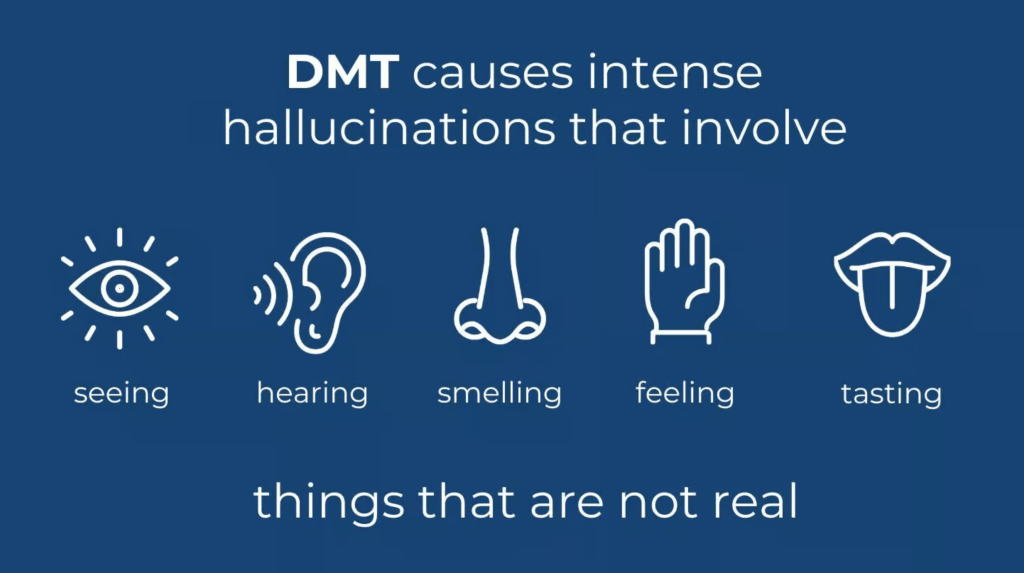
- Smoked/Vaped DMT Peak: The most intense phase hits almost immediately after onset and typically lasts about 5–10 minutes at most . Within the first minute or two of inhaling, users are often propelled to the peak – a state of powerful visuals and complete immersion in the experience. This peak is when phenomena like breakthrough visions, ego dissolution, and encounters with mystical or alien landscapes occur. It’s a white-hot burst of intensity that often defies description. After roughly 5 to 10 minutes at this peak, the effects start to rapidly decline. By 15–20 minutes in, the person is usually well past the peak and gliding downward. Notably, time distortion is common: those 5 minutes can feel vastly longer. DMT reliably warps one’s sense of time, so minutes may feel like hours on the peak . Many users come back astonished that so little clock time passed during what felt like an epic journey.
- Ayahuasca Peak: The strongest effects of ayahuasca tend to span 1 to 2 hours within the overall 4-6 hour experience. After the initial hour-long onset, the effects usually intensify to a peak that can last a couple hours in the middle of the journey. During this time, visionary hallucinations, deep introspective or emotional experiences, and physical reactions (like purging or trembling) may occur. The peak of ayahuasca is less spike-like than smoked DMT; it’s more of a plateau or a series of cresting waves spread out over an extended period. Users might have multiple visions or insights unfolding over this peak period. While less instantaneous than smoked DMT, ayahuasca’s peak can be very intense in its own way – sometimes overwhelming nausea or emotional catharsis accompanies the visions.
- 5-MeO-DMT Peak: If vaporized, 5-MeO-DMT’s peak comes on very fast (within 2–5 minutes) and can last around 10–20 minutes of utter immersion . 5-MeO-DMT is known for a different character of experience (often less visual and more about loss of self or “white-out” unity experiences), but it shares the rapid rise and short peak duration with N,N-DMT.
In summary, a smoked DMT trip hits its climax almost as soon as it begins – it’s a rapid fireworks burst of psychedelic effects that begins to fade just a few minutes later . Ayahuasca, on the other hand, climbs to a high plateau where the strongest effects persist for a couple hours before slowly tapering. Both can feel timeless and profound during the peak, even though the clock might say only minutes or hours have passed.
What Is the Come-Down Like and Are There Aftereffects?
After the peak of a DMT experience, there is usually a come-down phase where one returns to baseline. Smoked DMT has a swift, sometimes abrupt come-down with relatively mild physical aftereffects, whereas ayahuasca’s come-down is more gradual and can leave a lingering “afterglow” (or occasionally exhaustion). Let’s break it down:
- Smoked/Vaped DMT Come-Down: Within about 10 to 15 minutes after the peak, most of the acute effects subside . Many users describe an “almost as sudden as it started” drop-off – one moment they are in a whirlwind of hallucinations, and minutes later the visuals and intensity recede quickly. This rapid return to baseline can feel jarring. There are usually few physical side effects during the come-down; DMT doesn’t typically cause the prolonged body load or chemical aftereffects that something like alcohol or MDMA might.
However, mentally and emotionally, one might feel stunned. It’s common to sit in silence trying to process what just happened. Some people report feeling a bit anxious or confused as they re-adjust to reality, especially if the trip was challenging . Others might feel euphoria, awe, or a sense of peace as the intense part ends. Notably, DMT’s come-down tends to lack the harsh “hangover” feelings that other hallucinogens (like LSD) can have . There may be a gentle afterglow of clarity or positivity that lasts for 15-30 minutes once you’re mostly sober. In some reports, users mention feeling mentally “reset” or unusually calm in the hour after a DMT trip. - Ayahuasca Come-Down: After peaking on ayahuasca, the effects taper off slowly over a couple more hours. The come-down from ayahuasca can involve physical exhaustion – the body may feel drained from purging (vomiting) or from the emotional intensity of the experience. It’s not uncommon to feel drowsy or weak as the visions fade. Many people experience a prolonged afterglow once the major effects are over: a state of clarity, improved mood, and introspection that can last through the next day .
This afterglow is often described in positive terms – for example, participants in studies have said “I felt free, carefree, re-energized” the day after ayahuasca . However, not everyone’s aftereffects are pleasant. Some might feel emotionally raw or vulnerable, especially if difficult personal insights were unearthed. Integration is key (more on that later). Generally, the immediate hours after an ayahuasca ceremony are for rest, reflection, and gentle activity; the mind can remain in a reflective, altered state for a while, even though hallucinations have ceased. - Psychological Aftereffects (All forms): DMT experiences – whether smoked or ayahuasca – can be profoundly memorable, and this can leave a lasting psychological impression. In the hours or days following, individuals might feel a sense of awe, spiritual insight, or puzzlement as they try to make sense of what they saw. Some report lingering calm and reduced fear of death (in positive cases), while others might feel unsettled or anxious for days if the trip was frightening .
Sleep can be impacted too: a powerful DMT trip might make it hard to sleep immediately afterward for some people (due to adrenaline or racing thoughts), whereas others sleep deeply after the emotional catharsis. Importantly, most standard doses of DMT do not produce long-lasting physiological aftereffects – it’s mostly the subjective mental impact that lingers.
In summary, smoked DMT drops you back to normal quickly – often within a half hour you’re essentially sober, just a bit wide-eyed by what happened. Ayahuasca gently lands you over a few hours and may leave a glow (or at least a significant memory). Both forms can have an afterglow characterized by elevated mood or clarity, and both can also leave difficult feelings if the experience was challenging. Fortunately, serious prolonged side effects are rare; DMT’s body load is short-lived, aligning with how fast it’s metabolized. Many users cherish the afterglow as a time to journal or contemplate insights while the experience is still fresh.
What Factors Influence How Long DMT Lasts?
The duration of a DMT trip isn’t set in stone – several factors can influence how long the effects last. Key factors include the dosage, method of administration, individual body chemistry, and even psychological elements like set and setting. Here’s a closer look at each:
- Dosage: The amount of DMT consumed plays a role in both intensity and slight variations in duration. A threshold dose of smoked DMT (say 5–10 mg) might produce a very short, mild effect – possibly under 5 minutes of noticeable visuals. In contrast, a breakthrough dose (e.g. 25–50+ mg vaporized efficiently) yields the full immersive experience and might extend the trip a few minutes longer simply because there is more compound to metabolize.
With ayahuasca, a stronger brew or larger volume can prolong the peak or cause a second wave of effects that lengthens the overall experience (e.g. from 4 hours up to 6 or even 8 hours in some cases). Generally, higher doses = slightly longer tail of effects, though DMT’s inherent short action keeps this difference relatively small compared to drugs like LSD. - Method of Use: This is the biggest determinant of duration. As discussed, inhalation vs. oral use produces radically different timelines. Smoking or vaping DMT gives the quintessential 5-20 minute blast . Taking DMT in an ayahuasca brew with MAOIs stretches the experience to several hours . Even among inhalation methods, there are nuances: vape pens or e-cartridges deliver DMT in a controlled vapor form, and some users find this method slightly prolongs the plateau compared to a single big pipe hit – possibly because one can take multiple small puffs to extend the experience a bit (still, we’re talking tens of minutes at most) .
Intravenous injection can produce a ~30 minute experience , whereas intramuscular injection might last up to ~60 minutes but at a gentler intensity . Changa, a smoking blend of DMT with herbal MAO inhibitors, is known to extend a smoked DMT trip’s duration by a factor of two or more (e.g. 15–30 minutes of effects instead of 5–15) because the MAOIs slow the breakdown of DMT in the lungs and brain. In short: how you take DMT decides if you’re in it for minutes or hours. - Body Chemistry and Metabolism: Individual differences in metabolism can affect duration. DMT is primarily broken down by the enzyme monoamine oxidase (MAO) in the body. Someone with higher MAO activity might clear DMT faster, potentially shortening the trip a bit, whereas someone with naturally lower MAO activity (or who has recently taken an MAOI antidepressant – though combining those is risky) might experience a somewhat longer or stronger trip. Additionally, factors like liver function (since the liver will metabolize DMT) and general metabolic rate can play a role.
Body composition – such as weight and hydration – might subtly influence how quickly the drug circulates and is eliminated, though with DMT’s brevity these differences are small. Tolerance to psychedelics is usually an issue with repeated use, but DMT is unique in that it does not produce a significant tolerance buildup even with frequent use . Studies have shown that giving DMT to the same person twice in one day produces equally strong effects each time, unlike LSD where the second day’s dose would be weaker . This means your body’s short-term regulation (like 5-HT2A receptor downregulation) doesn’t cut a DMT trip short – it will last as long as it normally does, even if you smoked earlier. - Presence of MAO Inhibitors: We touched on this with ayahuasca and changa, but it’s worth emphasizing: MAO inhibitors extend DMT’s duration. Ayahuasca’s 4-6 hour length is due to the MAOI (e.g. harmine, harmaline) preventing the breakdown of DMT in the gut and liver . Even a pharmaceutical MAOI (like moclobemide) taken before DMT can turn a smoked DMT trip into an orally active one often called “pharmahuasca,” lasting 1-2 hours or more.
If someone were on prescription MAOIs and smoked DMT, they might also find the effects unusually prolonged and intense (and potentially more dangerous due to interaction). So any chemical that slows DMT’s metabolism will lengthen the trip. Conversely, certain substances that induce liver enzymes might shorten it (though this is not well documented for DMT specifically, it’s a theoretical possibility). - Set and Setting (Subjective Time Perception): Interestingly, one’s psychological state and environment can influence the perceived duration of a DMT trip, even if not the actual pharmacological duration. In a comfortable setting, a brief trip might feel blissfully timeless. In a frightening setting, a 10-minute DMT peak could feel like an eternity of horror. Psychedelics are known to distort time perception greatly. Anxiety can make time seem to drag, whereas a state of flow or awe might make hours feel like minutes. While this doesn’t literally change how long DMT’s effects last in your system, it definitely influences how long it feels.
For example, many users on forums note that even though DMT’s effects came and went in 15 minutes, it felt like they spent days in some other realm. This is due to the way DMT alters cognition and time processing in the brain . Setting (the surroundings, music, lighting) can also modulate how one integrates the passage of time during the trip.
A calm, dark room might lead to less awareness of time entirely, whereas a distracting environment might occasionally remind the person of time (“oh, the music track changed, it must be 5 minutes in”). So, while set/setting don’t change the drug’s metabolism, they influence the subjective duration and one’s memory of it.
In summary, how long DMT lasts depends on how you take it, how much you take, and your body’s chemistry. By far the most critical factor is the route of administration – that’s the difference between minutes and hours. Dose can slightly stretch things, and biological factors like enzymes can tweak it, but the underlying profile of DMT is always short-acting relative to other psychedelics. Finally, remember that your mind is part of the equation: DMT can bend time in your perceptions, so that a short trip can feel incredibly deep or “long” in a psychological sense.
How Does DMT’s Duration Compare to Other Psychedelics?
DMT is often contrasted with other well-known psychedelics for its rapid onset and short duration. Here’s a comparison to put DMT in context with LSD, psilocybin (magic mushrooms), and even ketamine and others:
- DMT (Smoked/Vaped): ~30 minutes total (with ~5–15 minutes intense) . This is remarkably short; DMT is one of the fastest-acting and shortest-lasting psychedelics known. It’s why it earned the moniker “businessman’s trip” – one could literally do it during a lunch break (though we don’t recommend that!).
- LSD (Acid): 8–12 hours duration . LSD is the opposite end of the spectrum – if you drop acid in the afternoon, you’re likely tripping until early the next morning. The peak of LSD might be 3–6 hours in, and aftereffects can linger into the next day. Compared to DMT, LSD is an all-day affair. People jokingly say “DMT is like blasting off to space, while LSD is like a long road trip”.
- Psilocybin Mushrooms: 4–6 hours of effects . Shrooms are shorter than LSD but still far longer than smoked DMT. A mushroom trip’s peak lasts 2–3 hours in, and by hour 5 or 6 you’re coming down. In terms of subjective effect, some compare a mushroom trip to a “moderate-length movie” whereas DMT is a “trailer” – extremely condensed. Notably, an ayahuasca trip (4–6 hours) is in the same ballpark as a mushroom journey, since chemically ayahuasca’s harmala alkaloids and DMT create a several-hour experience somewhat akin to a very intense set of mushrooms or a shorter LSD trip.
- 5-MeO-DMT: ~20 minutes (smoked), up to 60 minutes (insufflated) . This analog of DMT is similarly short. People sometimes call 5-MeO-DMT the “flash” because of how fast and overwhelming it is. It’s only marginally longer than N,N-DMT in some cases.
- Ketamine: ~45 minutes to 1 hour (intramuscular or insufflated) . Ketamine is a dissociative, not a classic psychedelic, but it’s worth mentioning since its duration (~an hour or less for the high) is also short relative to LSD or shrooms. However, even ketamine tends to last a bit longer than smoked DMT and with a slower come-down. A strong ketamine experience (“K-hole”) might have 20–30 minutes of peak and a gradual reintegration over another half hour. So in hierarchy: DMT < Ketamine < Mushrooms < LSD in terms of trip length.
- Salvia divinorum: ~5–15 minutes. Salvia is another peculiar plant that causes brief, intense hallucinatory experiences when smoked. Its duration is comparable to DMT (very short), though its effects are quite different in character. We mention salvia just to note that DMT isn’t entirely alone in the “ultra-brief trip” category, but salvia’s use and cultural context differ.
- MDMA (for comparison): ~3–5 hours. MDMA (ecstasy) is not a hallucinogen in the classical sense, but sometimes people compare durations. MDMA’s euphoric effects last much longer than a DMT flash but shorter than an LSD trip.
In essence, DMT stands out as one of the shortest psychedelic experiences available. Most classic psychedelics require a half-day commitment or at least a whole evening. DMT, especially smoked, is more like a sprint – incredibly fast and intense, over almost as soon as it began. This makes it attractive to some (for instance, those who don’t want a long drug effect or who are curious but time-constrained) and intimidating to others (since the rapid onset leaves little time to adjust). It also means DMT could potentially be used in therapeutic settings without the marathon sessions required for LSD or psilocybin therapy – short-acting psychedelics like DMT and 5-MeO-DMT are being researched for their ability to induce rapid, profound experiences in a clinical timeframe .
To put the comparison in a memorable way: DMT is like a lightning flash – brilliant and short-lived – whereas LSD is like an all-day thunderstorm, and mushrooms are a long rain shower. Each has its place, but DMT’s brevity is a defining feature that sets it apart in the pantheon of psychedelic substances.
What Is the DMT Afterglow and How to Integrate the Experience?
Many users report an “afterglow” following a DMT trip – a period of residual effects that can include euphoria, mental clarity, or emotional sensitivity once the intense hallucinations have faded. This afterglow can last for hours or even days in subtle form, and integration practices are recommended to make the most of the experience. Here’s what that means:
- Afterglow Defined: The psychedelic afterglow refers to positive effects that remain after the primary drug effects have ended. In the case of DMT, once you’ve come down (e.g. 30 minutes after smoking, or the day after an ayahuasca ceremony), you might still feel different from your normal baseline. Common afterglow effects from DMT include mood elevation, a sense of wonder, peacefulness, increased appreciation of life, and sharpened mental clarity.
Physically, one might feel a comforting warmth or just normal with less tension than before. Studies of ayahuasca drinkers have noted improved mindfulness and cognitive flexibility in the afterglow period . One user’s description: “All that day and well into the next, a high…energy persisted” , capturing the extended positive vibe an ayahuasca afterglow can give. Not everyone gets a glowing afterglow; some might just feel normal, or even a bit mentally fatigued. But a significant number of people cherish the post-DMT headspace as a time of introspection and contentment. - Negative Aftereffects: It’s worth noting that not all aftereffects are rosy. Particularly if the DMT trip was frightening or chaotic, a person could be left feeling dazed, anxious, or emotionally raw. For example, some DMT users have reported being shaken and unsettled for days after a tough experience . Nightmares or difficulty focusing on daily tasks can occur in those cases. These instances underscore that integration is crucial; without it, a powerful experience (good or bad) can leave one feeling ungrounded.
- Integration Practices: Integration means taking the insights or effects of the DMT experience and processing them in a healthy way to incorporate any lessons into your life. Because DMT is so fast-acting, the real work often begins after the trip.
Some recommended integration practices include: Journaling about the experience (as soon as you’re able, write down what you saw, felt, and thought – this helps capture details that memory might otherwise let fade, and gives you material to reflect on), meditation or mindfulness in the days following (this can help you center yourself and possibly continue the introspection that the DMT sparked ), and talking with a trusted friend or therapist about it. If you have access to a community or integration circle (common in contexts of ayahuasca or other entheogens), sharing your experience in a safe group setting can be very beneficial.
Artistic expression is another integration tool – some people draw or paint motifs from their visions, or play music that resonates with what they felt. The goal of integration is to make sense of the experience and apply any positive insights to your daily life . For instance, if DMT gave you a sense of awe at life, integration might involve renewing your daily gratitude practice or repairing relationships that suddenly seem more precious. If it surfaced fears or traumas, integration might mean seeking therapy or engaging in healing practices to address those. - Why Integration Matters: A psychedelic trip as short as DMT’s can nonetheless be extremely impactful. Without integration, one might simply shrug it off as “weird drugs” and miss potential personal growth, or conversely remain spooked by it. Integration helps in transforming the afterglow into lasting positive change . The afterglow period is sometimes called a window of increased psychological openness – you might be more able to adopt new perspectives or break old habits.
Capitalizing on that with good intentions (like deciding to quit smoking, or to spend more time with family, or to pursue a spiritual practice) can give the ephemeral DMT experience a long-term benefit. Researchers have even started developing integration scales to measure how well individuals incorporate their psychedelic experiences into their lives , underlining how crucial this phase is in psychedelic-assisted therapies.
In practice, after a DMT trip it’s wise to give yourself quiet time to reflect. If it was smoked DMT, you might spend the next hour in a calm environment, perhaps listening to soft music or sitting outside, just digesting emotionally. After ayahuasca, integration is often more formal – you might have a sharing circle the next morning, or at least a day of rest to journal and meditate. Listen to your mind and body: if you feel inspired, create something or talk it out; if you feel vulnerable, ensure you have a safe, comforting space and perhaps someone to talk to who understands. The afterglow can be a beautiful phase of its own – some say the real insights come in the days after, as they realize what the experience meant for them.
Frequently Asked Questions about DMT’s Duration
Why does a DMT trip feel longer than it really is?
Many people report that a DMT trip feels much longer than a few minutes. This is due to profound time distortion under the influence of DMT. Psychedelics in general can alter the brain’s time perception; with DMT, users commonly experience a sense that time has slowed down or even stopped. In the bizarre, immersive realm DMT creates, normal timekeeping disappears – you might live out an entire journey or see innumerable visions in what turns out to be just 10 minutes of real time. As one Reddit user aptly put it, with psychedelics “minutes feel like hours” because your mind is processing so much information and the usual reference points for time (like short-term memory sequencing) are thrown off .
DMT’s “time-dilatory” effects are well documented . Essentially, your brain is in a dreamlike state where it can form a lot of impressions very quickly, and without external inputs (especially if eyes are closed) a minute can subjectively stretch out. So, the intensity and novelty of the experience makes it feel longer. This is why integration is needed – even though it was 10 minutes, it might take days to unpack the “hours” of experience your mind felt it went through.
Can you make a DMT trip last longer on purpose?
In general, you cannot easily extend a smoked DMT trip much beyond its natural duration without changing the method or adding other substances. DMT’s effects decline as the molecule is rapidly metabolized. Taking additional hits of DMT back-to-back usually doesn’t work well – there seems to be an immediate tolerance or simply a point where the receptors are saturated. Some users have tried “redosing” during a trip to prolong it, but often by the time you’re able to take another hit, you’re already coming down and the second dose has diminished effects. The most practical way to extend a DMT experience is to use an MAOI.
For instance, smoking changa (DMT infused in herbs containing MAO inhibitors) can stretch the experience to 15–30 minutes instead of ~10. Drinking ayahuasca, of course, extends it to hours. Another method sometimes mentioned is using slow-release vape techniques – e.g. taking small puffs periodically to maintain the plateau. While a DMT vape pen can allow some dosing control, there’s a limit to how long one can practically keep inhaling more DMT; typically the intensity peaks and you might be too incapacitated to continue inhaling.
There is also research into pharmacological prolongation, but nothing widely available (this would involve administering additional compounds to keep DMT active – not something people can do at home safely). In summary, unless you switch to an ayahuasca/pharmahuasca approach, DMT’s nature is to be fleeting. It’s often said that part of DMT’s magic is that it forces you to “let go” precisely because you can’t hang onto it for long. If you want a longer psychedelic state, substances like psilocybin or mescaline might be better choices than trying to force DMT to last longer.
How long does DMT stay in your system (for drug tests)?
Chemically, DMT is eliminated from the body very quickly. Your body breaks down and clears DMT in a matter of hours. One study on injected DMT found it was below detectable levels in blood after 1 hour post-dose . In general, for drug testing: DMT is not included in standard drug screens, and even if it were, the window of detection is short. In urine, trace amounts might be detectable for about 24 hours to a few days at most , but most standard tests wouldn’t flag it. Specialized tests (which are rare) could find it in urine for maybe 24-48 hours.
In blood, it’s gone in a few hours. In saliva, possibly a half day. Hair follicle tests could show DMT use up to 90 days later – however, hair tests for DMT are extremely uncommon (and any psychedelic use via hair is hard to interpret). It’s worth noting that because DMT is a naturally occurring compound in the human body (in trace amounts), extremely sensitive tests might always find a baseline level in urine or blood; but this isn’t enough to suggest an active use, and most testing protocols ignore DMT.
As an example reference, some resources note detection times like 2 hours in blood, 12 hours in saliva, ~24 hours in urine . But again, most drug tests do not target DMT at all – it’s more of an exotic substance in testing terms. So unless you are specifically being tested for psychedelics (which usually only happens in certain legal or medical investigations), it’s unlikely DMT use will be detected after the fact. Always be cautious though – if you have a drug test soon, it’s safest to avoid substances.
Does using DMT repeatedly build tolerance or affect how long it lasts?
Surprisingly, DMT does not seem to produce significant tolerance to its effects, especially in the short term. This is unusual because most classical psychedelics (like LSD, psilocybin) cause rapid tolerance – if you take LSD two days in a row, the second day’s effects are much weaker. DMT is different: studies and anecdotal reports indicate you can smoke DMT multiple days in a row (even multiple times a day) with full effects each time .
Research in the 1990s (Strassman’s work) gave volunteers DMT injections repeatedly and found no tolerance buildup in terms of the psychedelic experience . This means that using DMT again won’t be noticeably shorter or weaker just because you did it yesterday. The lack of tolerance likely relates to DMT’s unique pharmacology – it doesn’t strongly desensitize the serotonin 5-HT2A receptors the way LSD does .
Some experts think the short duration itself might be the reason; the brain isn’t stimulated long enough to down-regulate receptors as it would during a longer trip . Now, over longer periods, one could develop some psychological tolerance or familiarity – the first trip might blow your mind, whereas the tenth trip, while just as potent chemically, might feel less shocking because you’re somewhat accustomed to the DMT state. But physiologically, each DMT trip is like a fresh experience.
This also implies that the duration of each trip stays consistent: using DMT repeatedly won’t shorten how long it lasts in a given session. The only caveat is if you try to immediately redose in the same session (within minutes), there’s anecdotal talk of a short-lived tolerance that might make it hard to breakthrough again. But give it a small break (even an hour), and DMT will hit like new. So, unlike many drugs, you won’t need to escalate dose to get the same duration/effect on separate occasions.
Nonetheless, due to the intensity of DMT, most people don’t binge it; they naturally space out experiences to integrate them. And that’s a good thing, because while tolerance isn’t a factor, each experience can be mentally hefty – it’s wise to give yourself time between trips, even if your brain’s receptors would technically be ready to go again soon.
Conclusion: A Short but Powerful Experience
In closing, DMT offers a psychedelic experience that is uniquely short-lived in duration but often immeasurable in impact. How long DMT lasts depends largely on the form: a smoked or vaped DMT trip will blast you into another reality for a few intense minutes and have you back down to earth within half an hour , whereas an ayahuasca journey will unfold over several hours of deep introspection and vision . In either case, the consensus is that DMT’s effects feel disproportionately profound for the brief time they occupy. One might experience in 10 minutes what other psychedelics might take 10 hours to show, which is part of DMT’s allure.
To recap, we learned that DMT kicks in almost instantly when inhaled and peaks within minutes, giving it the fastest takeoff of most psychedelics. The trade-off is that it also ends quickly – “quick in, quick out.” Ayahuasca extends that timeline thanks to MAO inhibitors, making DMT more like a traditional lengthy trip. We compared DMT’s timeline with LSD, shrooms, and others, highlighting just how special that short window is. And despite being short, DMT can leave a lasting afterglow and plenty to think about, which is why integration is crucial to make sense of the experience afterward.
Ultimately, the question “how long does DMT last?” has two sides: there’s the literal pharmacological duration (minutes or hours, depending on method), and there’s the subjective, psychological duration (which can feel timeless). Both are important for would-be travelers to understand. DMT is a burst of the extraordinary, a brief journey that can be beautiful or challenging, but either way, it tends to be intense. Knowing the timing – that the peak will be over soon, that you’ll be back to baseline relatively quickly – can be reassuring to those who are nervous. And for the curious, it emphasizes DMT’s role as a powerful yet fleeting tool for exploring consciousness.
If you’re considering an experience, remember: short does not mean shallow. DMT’s brevity contains incredible depth. Treat the experience with respect, prepare adequately, and have a plan for integrating whatever you learn. In just a few minutes, DMT might show you a panorama of consciousness that leaves you changed. Then, as fast as it began, you’ll be back, looking at the clock in disbelief that only 15 minutes passed. That’s the mystery of DMT’s duration – it’s here for a moment, gone in a flash, but what you glimpse in that short eternity could stay with you for a lifetime.
SEO Title: How Long Does DMT Last? DMT Vape vs. Ayahuasca Trip Duration
Meta Description: How long does DMT last? Learn the onset, peak, total trip duration, and aftereffects of DMT – from a fast 15-minute DMT vape pen experience to a 4–6 hour ayahuasca journey – all backed by research and expert insights.